Every few months a client asks me the same question. They have been reading about headless CMS, someone in their team mentioned Next.js, and now they want to know if they should move away from WordPress. The WordPress vs headless CMS debate is louder than ever in 2026. And most of the content written about it is either written by someone selling a headless platform or someone defending WordPress at all costs. This is neither. This is what I have seen working with both approaches across real client projects.
First, What Does Headless Actually Mean
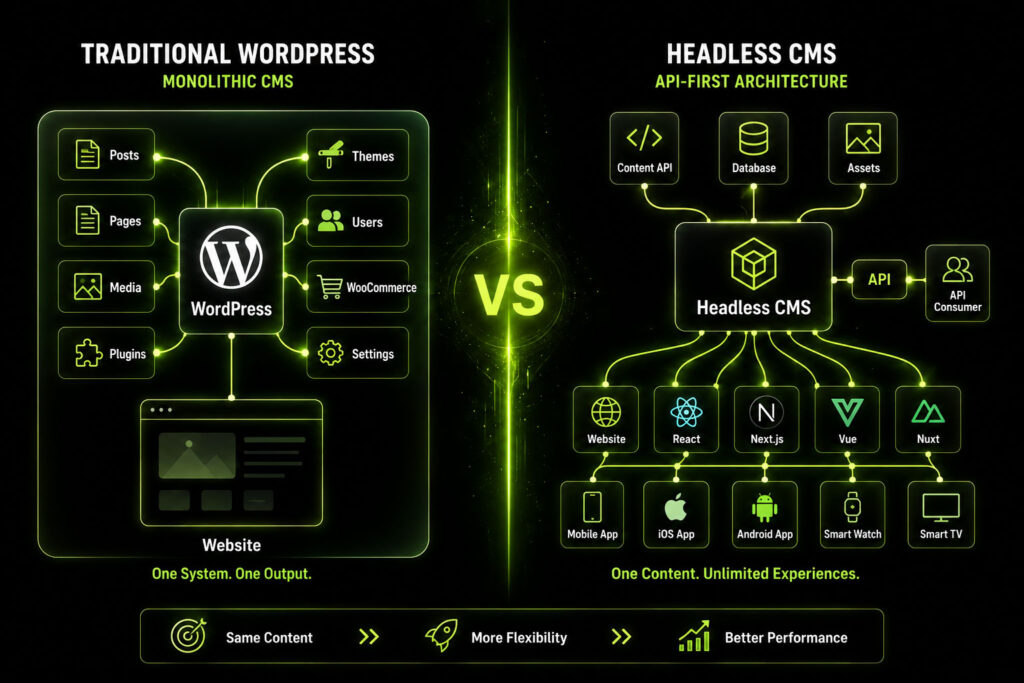
Traditional WordPress is a coupled system. The backend where you manage content and the frontend where users see it are connected. WordPress controls both.
Headless separates them. Your content lives in a CMS — WordPress, Contentful, Sanity, whatever — and your frontend is built separately in React, Next.js, or any other framework. The two talk to each other through an API.
That separation is the entire point. It gives your frontend complete freedom. You are no longer constrained by WordPress themes or PHP templates. Your React developer can build whatever they want.
Sounds great. And sometimes it is. But the gap between the theory and the reality is where most clients get surprised.
Where Headless Actually Wins
There are specific situations where headless is genuinely the better choice. Not because it is modern or because agencies charge more for it. Because the project actually needs what it offers.
- You are delivering content across multiple channels simultaneously. Same content going to a website, a mobile app, a digital display, and an API consumer. A coupled WordPress site cannot do this cleanly. A headless CMS can.
- Your frontend has complex interaction requirements. Highly animated experiences, real-time data, app-like navigation — these are awkward to build inside WordPress theme constraints. A React frontend with a headless backend is the right call.
- You have a dedicated frontend team that works in React or Next.js and does not want to touch PHP. Forcing a React developer into WordPress theme development is a waste of their skills and your money.
- Performance is a hard requirement, not a nice-to-have. Statically generated Next.js sites are fast in ways WordPress with caching plugins can approximate but not fully match.
Headless is not better than WordPress. It is better for specific problems. Knowing the difference is what you are actually paying a developer to figure out.
Where WordPress Still Wins in 2026
Here is what the headless community does not talk about enough.
WordPress powers around 43% of the web. Not because developers love PHP. Because it solves real problems for real businesses without requiring a team of engineers to maintain it.
A marketing manager can update a WordPress site. They can add a blog post, change a banner, update pricing, upload a case study. Without filing a ticket. Without waiting for a developer. Without touching code.
Take that same business and put their content in a headless CMS with a Next.js frontend, and suddenly every content update requires a developer to check if anything broke. Every new page type requires frontend work. The content editor who used to be self-sufficient is now dependent on the tech team for things that used to take five minutes.
That hidden cost is real. And most headless proposals do not put it in the budget.
- WooCommerce on WordPress handles ecommerce for hundreds of thousands of stores globally. The plugin ecosystem, payment integrations, shipping logic, and inventory management built on top of WooCommerce would take years to replicate in a custom headless build.
- WordPress SEO is solved. Yoast, RankMath, schema markup, sitemaps, redirects — all handled. In a headless setup, your developers are implementing this from scratch or paying for additional tooling.
- The maintenance overhead of a headless stack is real. Two systems to update, two systems to secure, two systems to monitor. For a small business, that overhead is often not worth the performance gain.
The Question Nobody Asks Before Choosing
After working with both approaches, the question I ask every client before recommending anything is this:
Who is updating this site six months after launch?
If the answer is a developer or a technical team — headless might make sense. You can build something clean, fast, and exactly right for your needs.
If the answer is a marketing person, a content manager, or the business owner themselves — the content editing experience of a headless CMS is going to frustrate them. WordPress’s admin is not perfect but it is familiar and it works.
Who updates this site six months after launch? That one question has saved more clients from a bad tech decision than any architecture diagram I have ever drawn.
What 2026 Actually Changed
The headless space has matured. Tools like Sanity, Contentful, and Payload CMS have much better editing experiences than they did two years ago. The argument that headless means a bad content editing experience is weaker than it used to be.
On the WordPress side, the block editor has improved significantly. Full Site Editing gives developers more control over layout. The REST API and WPGraphQL make WordPress work reasonably well as a headless backend if you want the WordPress editing experience with a custom frontend.
What has not changed: the fundamental tradeoff. Headless gives you frontend freedom and performance at the cost of complexity and maintenance overhead. WordPress gives you a proven content management system at the cost of frontend flexibility.
Neither is disappearing. Both are getting better. The right choice still depends on your specific project.
My Honest Decision Framework
Before I recommend anything, I map out three things:
- Data model: Is the content primarily posts, pages, and products? WordPress. Is it a complex relational structure with multiple content types feeding multiple surfaces? Headless.
- Team: Who builds it, who maintains it, who updates it. A mismatch here causes more problems than any technical decision.
- Timeline and budget: Headless projects take longer to build and cost more to maintain. If the budget does not support that reality, build a great WordPress site instead of a half-finished headless one.
The worst outcome I see regularly: a client gets sold a headless build because it sounds modern, the agency charges a premium for the React frontend, and six months later the client cannot update their own website without calling a developer for every small change.
The second worst outcome: a client with genuinely complex multi-channel requirements stays on a coupled WordPress setup because nobody explained that there was a better way.
Both outcomes are preventable with honest scoping at the start.
Not sure which approach is right for your project? I work with both WordPress and headless setups and will give you a straight answer based on what your business actually needs.